
Articles & Analyses
Dr. Gentiana Sula
Chairwoman of the Authority for Information on Documents of the former State Security
Spaç in the light, access to primary sources for a fair and inclusive memory
Returning to the communist past of Albania also brings the remembrance of a profound darkness. The forced labour camp of Spaç, an open wound in our history, was a place where freedom and rights were violated and around 2,000 men, as well as their families, were treated in an inhuman manner. Today, the effort to understand this heavy past is necessary so that it never repeats itself.
By enabling access to primary sources that facilitate critical thinking and more in-depth analysis of this dark episode, the identification of documents in the archival ordering for Spaç and of the persons who suffered there was carried out, as well as the collection of testimonies, photographs and letters, etc., thus bringing an irreplaceable contribution of AIDSSH.
The publication entitled “50 years since the revolt in the prison of Spaç – Survivors and their families testify” carries the importance of recognizing the history of the prison and forced labour camp of Spaç as an emblematic place where the ferocity of the communist dictatorship is manifested. Within this camp we find the victims of the regime, their profile in Albanian society of the time, the descent into the most brutal prison of the country, the suffering, hardships and terrible consequences that fell upon them in the Albanian gulag.
In the darkness of the prison we also find notes of resistance against the regime, something quite rare at that time and in that context. For this reason, this publication also examines the revolt of the convicts of Spaç dated 21–23 May 1973. This revolt, due to the dimensions it assumed, is considered the most important in the prisons of communist Albania. After the violent suppression of the revolt, 4 political prisoners were executed by firing squad, while around 70 others were re-sentenced. The bodies of those executed remain to this day unlocated.
Although the typology of this prison-camp has been addressed, many facts remain unclear. This study comes to light in this publication to provide answers to many questions, such as: Do we fully know forced labour as a means of punishment for political prisoners? What were the most pronounced dehumanizing features of the system? In which moments are violations of human rights against prisoners evidenced?
Through this publication and others of this nature, the Authority aims to fulfill the objectives of
the Strategic Plan 2023–2028, which identifies the presentation of the Authority as a platform for public engagement and understanding of the communist past in Albania. The collected facts support the process of identifying and rediscovering the remains of victims who were disappeared or executed during communism.
The historical and social context of the events covered in the publication
Camp no. 2 was stationed in Spaç in 1968, after more than 17 years as a mobile labour camp where mainly political prisoners were engaged, which in official documents is called “Re-education Unit 303, Spaç–Mirditë.” Only in July 1991, with the fall of the communist regime, was the Spaç prison-camp definitively closed.
The 1960s represent, in the history of dictatorship in Albania, the years of great isolation, which in the external context began after Albania’s break with the Soviet Union and the collapse of relations with all communist countries of the East.
But this period also coincides with the beginning of a new friendship of the Tirana regime and its alignment with the Chinese model of totalitarianism, another Stalinist version of the dictatorship’s approach to freedom and to people who manifested it.
In this period, due to rapid economic decline and lack of resources, the regime increased repression, while this time was also marked by a collapse of trust within the communist leadership itself. As a result, new hostile groups were uncovered.
Violations of human rights reached their peak during this phase. In 1961 Albania counted 4,345 prisoners, divided into six labour camps and four prisons. During the 1960s the class struggle returned even more to Stalinist methods. Trials and death sentences resumed. In these years, 139 executions were carried out.
Forced labour was widely used as a repressive and exploitative mechanism for political prisoners throughout the 45 years of the regime’s history. According to a report of the U.S. Department of State addressed to the United Nations in 1955, forced labour was used extensively in Albania since the communist regime came to power in November 1944. On 25 May 1951, the Minister of Internal Affairs ordered the creation of camp no. 2, later called “Unit 303.” In the period 1951–1968, political prisoners of this camp worked under coercion and in difficult conditions on the opening of the Peqin–Kavajë canal, Vjosë–Levan–Fier, Devoll–Thanë. They built the aviation field in Ura Vajgurore, Rinas Airport, the Sanatorium, the Meat Combine, the Tannery, the “Gjergj Dimitrov” farm, the Tractor Plant, the Caustic Soda Plant, the Cement Factory in Elbasan. In 1968 political prisoners were transferred to the copper and pyrite mine in Spaç. Copper ore was in demand on foreign markets and its price was highly advantageous for the closed Albanian economy. The regime itself had begun efforts to build a closed processing cycle for the ore, while with Chinese assistance a unit for separating gold from the ore was also established. The plan for extracting copper and pyrite was determined by the command. The daily quota was announced every day during roll call. Fulfilment of the quota and realization of the plan was a non-negotiable condition for the camp leadership. The daily quota for a wagon loader was 4 wagons. One pyrite wagon was 2 tons and one copper wagon were 1.5 tons. In the case of failure to meet the quota, prisoners were punished and confined in isolation cells. Data that emerged from the “Albakër” archive showed that in 1969 the mining system extracted only 50,000 tons of copper, while in 1981 production increased by about 200,000 tons per year. From the cross-referencing of archival documents, the working group at the Authority concluded that over 23 years Spaç turned into a forced labour camp, where 2,000 political prisoners produced 2.82 million tons of copper and 1.3 million tons of pyrite, from which 2,500 kg of gold were obtained. Each convict who fulfilled the quota was paid 10% of the wage of a free miner. In 1953 it was decided that when a convict exceeded the quota by 100% he had the right to a sentence reduction of 0.02 days per month and a payment of 35% of the value performed. In case of failure to meet the quota, payment was reduced in inverse proportion. In July 1968, the reward of payment and reduction of prison days was removed for political prisoners who exceeded the plan by 25%, arguing that forced labour was no longer serving re-education, but personal benefit. Location and status of the Spaç camp Spaç is located in the northeastern part of Mirditë, in a barren rocky area, without vegetation, far from residential centres. The harsh relief is accompanied by a stream with waters that have taken the pale colour of copper ore. The climate, with unbearable heat in summer and frost in winter, made Spaç a perfect terrain for isolating prisoners. The construction of the camp began with the erection of several old buildings, but later it was consolidated by building two blocks of flats, while at the same time the copper mine galleries were opened not far from the site where the camp was established. A few kilometers further, the copper enrichment plant was built in Reps, while about 10 km to the south was the Copper Smelting Plant in Rubik together with the gold separation facility. In January 1969, the Directorate of Internal Affairs of Mirditë (the State Security branch) opened the file of the “Object of special importance for Re-education Unit 303, Spaç–Mirditë,” thus defining its special status in relation to the strict control exercised and the aim of “physical security of prisoners, re-education and activation in work.” Until the beginning of 1980, the number of prisoners ranged between 900 and 1,200 persons. In reports of that year its importance was defined as “political, economic and strategic.” Living and working conditions of prisoners in the camp The testimonies and documents included in this publication speak of torture, violence, punishments in isolation cells at temperatures of −15 degrees, deaths from gallery collapses, suicides from despair. Ilias Kajo, convicted on the charge of “agitation and propaganda,” served an 8-year sentence in Spaç. “The wake-up bell rang at 5 o’clock. After roll call, at 6, we left the camp and climbed the mountain. We walked an hour and a half until we reached the gallery. There we greeted each other with the expression ‘Come out alive!’, because we might not come out alive again.” Political prisoners in this camp were a work machine. From their labour, considerable revenues were secured and used by the Ministry of Internal Affairs and the Ministry of Finance for investments. Work was in three shifts, the first starting at 6:30 and the last at 22:30. Food was scarce; it was considered a festive day by prisoners when beans were served, and dinner ended with tea and a little bread. Health care was insufficient; hygiene and cleanliness were alarming.
The working group established by Order no. 22, dated 06.02.2023 of the Chairwoman of the Authority, for organizing commemorative activities on the occasion of the 50th anniversary of the Spaç Revolt, produced over 50 audio-visual testimonies of survivors of imprisonment in Spaç and family members of those executed.
Spaç has been spoken about extensively over the years. Well-known figures of the time have testified about it, such as Visar Zhiti, poet and former minister, Fatos Lubonja, publicist and media activist, the painter Maks Velo, but AIDSSH went further by expanding the circle of witnesses. Their voices, silent until yesterday, are now part of history. The questionnaire prepared by AIDSSH experts helped secure authentic testimonies from this camp.
The following interviews speak of hard labour, brutal treatment, the reasons for the revolt, solidarity and family resistance, children’s dreams for education cut short, the stigma of the “enemy of the people,” as well as the meaningful hope that the remains of missing family members will one day return to their families.
Gëzim Çela was only 21 years old when he was arrested “for attempted escape.” He recounts that he exceeded the work quota. “If you met the quota they didn’t bother you. I loaded four wagons a day with pyrite; otherwise the isolation cell awaited me.”
Musa Hoxha, convicted “for agitation and propaganda” at the age of 21, worked in the most difficult zone of the mine, zone 2, without technical safety and at temperatures of 45–50 degrees. “Often when I couldn’t meet the quota, they would tie me for two or three hours with handcuffs to a pole, in the snow. In one of these punishments the irons burst my veins and I fainted. After that I did everything possible to meet the quota because I couldn’t endure the isolation cell or being tied to the pole. The cell was terrible. 2–3 square meters, only in socks, they took even your coat and wool sweater. They gave you a blanket only at 7 o’clock.”
Ilir Malindi, convicted at the age of 20, recounts: “I, as a miner, worked in the second zone, the pyrite zone. Pyrite is material from which sulfuric acid is extracted; one pyrite wagon weighs 2 tons. We had to extract four wagons each, meaning 6 tons per person.
We were organized in groups, 3 people per group, tasked with extracting about 20 tons of material outside. Pyrite has the characteristic of generating high temperature in reaction with water and humidity, so temperatures at the workplace reached 45–50 degrees.
From 45 degrees you went out to −15 degrees to unload the material. Outside it was freezing cold and you had to do this work during the day. If the quota was not met, they had an expression: ‘either the quota, or the soul!’ This was the dilemma; failure to meet the quota meant the isolation cell.”
Shkëlqim Abazi was only 16 years old when he was sentenced. “The Spaç Revolt was not spontaneous; there had been 30 years of uninterrupted violence; one day it would explode. Before the revolt broke out, it was Sunday. A large part of the political prisoners did not want to go to work, because legally Sunday was recognized as a day of rest,” Abazi recounts.
Gëzim Çela, former prisoner, says that the convicts initially threw slogans against hard labour in the mine, but later they turned into political calls such as: Down with communism! Long live Free Albania! Our mothers dressed up in black! We want Albania like all of Europe!
Napoleon Gumeni was 10 years old in April 1970 when his father, Izet Gumeni, was arrested and sentenced to 25 years imprisonment on charges of collaboration with bands: “I do not forget. I was 14 years old. Together with my younger sister we arrived around two o’clock in Spaç. The policeman did not allow us to meet our father that day, telling us he was at work. We slept behind a command barrack, battered by the cold wind of the Spaç gorge.”
Menduhije Pojani, daughter of Njazi Bylykbashi, former prisoner convicted “for agitation and propaganda” who served his sentence in Spaç prison: “After my father’s sentencing, my mother had to raise four children. She worked all day in agriculture, carried wood on her back to warm and feed us. Our grandmother, at an advanced age, also helped us.”
Lirie Alibali, wife of Ylli Alibali and sister-in-law of Xhevat Alibali, former prisoners convicted on charges of “agitation and propaganda”: “After my husband’s arrest, all doors were closed in my face. No one wanted to have anything to do with me. Relatives told me: ‘You came today, don’t come again!’ People moved away and changed roads because they didn’t want to speak to me, as I was stained in biography. I could not separate from the father of my daughters. I accepted my fate!”
Ioann Çeli was 16 years old when his father was arrested, a military man convicted on charges of “violent acts against the people’s power”: “After my father’s arrest, my older sister, who was studying at the Faculty of Philosophy in Tirana, was ceremonially expelled from school. They wanted to bring her out for public denouncement in front of the school.”
Leonard Bejko was 5 years old when his father, Dervish Bejko, was executed, convicted in 1971 on charges of “attempted escape.” He is one of those sentenced to death from the Spaç Revolt that broke out on 21 May 1973: “My father is my sorrow. I have a great emptiness because I grew up without him. In Pogradec I have built a grave in his memory. When I visit it, I light a cigarette. But for whom do I light it?! There are no bones. I light it for the earth, the cold marble.” The testimonies collected, carefully administered, will be made available to any researcher, at any time, according to the rules of archives in the Republic of Albania and the will of citizens who entrusted us with their stories through the agreement signed with the interviewer. AIDSSH undertakes to administer and preserve these recordings according to the standards of a valuable historical archive.
The twenty selected interviews are valuable sources for scientific research that complement archival documents and highlight those events that were intentionally overlooked in the official documents of the former State Security.
Alongside the challenges of rewriting our dictatorial past, these testimonies hold exceptional value, as biological time moves on and the risk of forgetting becomes ever more present.
Within the framework of academic studies on forced labour during the dictatorship, also stemming from the recurring need that history must be rewritten and never bears a final seal, shedding light on the Spaç prison-camp adds archival and historical sources to inform Albanian society about the repressive and dehumanizing mechanisms used by the state during the years 1944–1991.
As the main source for this publication, the AIDSSH archive was used, with documents from the file of the “Object of special importance of Unit 303, Spaç,” investigative–judicial files of prisoners in this prison, etc. The publication was enriched by the oral archive, which, although a secondary source, is equally important as it offers living testimonies. They are a bell of reflection for today’s society, which must not repeat the mistakes of the past.
The Authority further deepened its work toward creating the archival collection, where archival documents of the former State Security were supplemented with other official documents secured through institutional cooperation. From holding a technical roundtable, data were obtained from the expertise of professors and mining engineers who had worked during the period in the sectors and galleries where Spaç prisoners were also active.
Contribution
The testimonies and information secured through communication with local institutions placed AIDSSH before new facts regarding the disappeared bodies of persons killed or who died while serving their sentences in Spaç prison.
Research conducted in documents of institutions such as the General Directorate of Prisons, the Ministry of Internal Affairs, and the General Directorate of Archives verified the fact that a portion of former prisoners, executed, killed or deceased from hardship and illness during imprisonment, work accidents or attempted escape, still do not have a grave.
Based on all this, the Authority also decided to initiate administrative investigation procedures to verify suspected burial sites and clarify the fate of 44 missing persons, cooperate with local government bodies to protect them from alteration, and cooperate with law enforcement institutions for the recovery of the remains of persons killed or deceased while serving their sentences in Spaç prison.
The disappearance of graves, as has been observed, was used by the regime for two purposes: not only to silence opponents and critics, but also to create insecurity and fear among others, forcing them to remain silent and not challenge authorities.
The publication highlights that the disappearance of bodies constitutes a violation of fundamental human rights declared in the Universal Declaration of Human Rights (UDHR) of the United Nations. Victims are also their families, who spend the rest of their lives seeking information about the disappeared.
The publication presents a progress report of the administrative investigation for the 44 missing persons in Spaç prison, as well as an overview of activities that AIDSSH has conducted in commemoration of the anti-communist Spaç Revolt.
The Importance of Preserving Collective Memory of These Traumatic Events
Preserving collective memory of these grave events is becoming increasingly important for the democratic future of the country. Lack of knowledge of the past risks manifesting reminiscences in social culture, but also in policymaking. Meanwhile, public, institutional and educational spaces remain uninformed in some aspects of the dictatorial regime.
The fall of the communist regime in Albania was not accompanied by an investigation of crimes committed by it; moreover, the perpetrators of these crimes never seriously faced justice and never publicly apologized to the victims of communist genocide. To date, these events have been absent from official history curricula, which according to expert assessments avoids discussion of serious human rights violations committed against various groups, or other sensitive topics of this period, and remains a challenge. Despite numerous projects aimed at improving the teaching of history in schools, critical thinking, historical empathy and multiple perspectives have still not been sufficiently encouraged.
In the interest of recognizing history and preserving memory, the Authority comes with special publications on the Spaç Revolt with texts for pre-university age groups written by children’s writers assisted by the academic expertise of leading historians of this period. A children’s book and an adapted film about the event and history are part of the educational platform “Let’s Learn About the Past – Open Educational Resources 1944–1991,” which aims to assist teachers of history, civic education, philosophy, language and literature in conveying the event to pre-university students.
Through this ensemble of media, educational and instructional productions, the aim is for the resonance of this historical event to become a symbolic day of remembrance for society, as well as to encourage further acts of reflection toward rehabilitating all former prisoners and transforming the Spaç prison-camp into a museum of collective memory to remember that crimes against human life and dignity were committed there..
For the realization of this publication, I thank the employees of AIDSSH in all directorates for their dedicated work. The question format was developed by the Directorate of Scientific Support and Civic Education. Transcription was done in AIDSSH offices, recorded audio-visual narratives were processed by the audio-visual sector. The archival document fund was collected and processed by the Directorate of the Archive.
I thank the Directorate of Interinstitutional Relations in the Process of Identification and Recovery of Missing Persons for communication with former prisoners for conducting interviews, as well as field work for carrying out administrative investigations of the missing in Spaç.
I thank for their expertise the professors and mining engineers, Dr. Viktor Doda, former Minister of Energy and Mining, former engineer in this mine, Prof. Dr. Kimet Fetau, lecturer in Geology–Mining, the economics expert Fran Gjergji from “Albakër,” and Dr. Femi Sufaj, researcher and Deputy Director General of Prisons.
This is a very voluminous and careful work and I thank all contributors, but especially the survivors of Spaç prison and long internments, as well as their families, who despite age, health condition and spiritual injury, expressed readiness and cooperation to give their testimonies, extremely valuable and irreplaceable for the revolt of prisoners in Spaç prison on 21 May 1973, as well as data on inhuman treatment and hard labour in the mine.
The totalitarian communist regime of Enver Hoxha, which governed Albania after World War II until 1990, was characterized by: massive violation of human rights, murders and executions, individual and collective (with and without trial), deaths in concentration camps, deaths from hunger, torture, deportations, enslaving labour, physical and psychological terror, genocide due to political origin or property inheritance, as well as violations of freedom of conscience, thought and expression, freedom of the press, freedom of religious belief and freedom of political pluralism. Raising awareness of Albanian public opinion, especially awareness of the younger generation about the inhuman crimes committed by Enver Hoxha’s dictatorial regime, remains a challenge for Albania.
Clarifying the history of the forced labour camp of Spaç confronts us with several unresolved issues, such as:
• Lack of accountability. Even though 30 years have passed, there is still a lack of accountability for crimes committed in that camp and in the forced labour system in general. Many of those directly responsible have evaded responsibility and have not been punished. • Empowerment of victims. Clarifying history gives survivors the opportunity to tell their testimonies and reaffirm their identity as victims. This is a way to regain control over the narrative and help heal psychological wounds. • Building a just society. The lack of accountability and justice to date shows that the process of building a just society remains unresolved. Clarifying history should serve as a step toward an inclusive process of building a truly just society. • Lack of institutional memory. State institutions have shown a lack of will to clarify and preserve collective memory of these events. This indicates an ongoing need to increase institutional responsibility and engagement in this direction. Ultimately, this clarification of Spaç history shows that we still have much to learn from the past in order to build a just and democratic future by fully confronting the truth of that time. Bibliography
Decisions and Orders
AIDSSH, Order no. 22, dated 02.2023 of the Chairwoman of the Authority, “On the organization of commemorative activities on the occasion of the 50th anniversary of the Spaç Revolt” AIDSSH, Decision no. 374, dated 02.06.2023 “On initiating administrative investigation with the aim of clarifying the fate, finding, identifying and recovering the remains of persons deceased or disappeared during the serving of sentences in Spaç Prison” AIDSSH, Decision no. 724, dated 12.2023 “On approval of the report on the administrative investigation with the aim of clarifying the fate, identifying and recovering the remains of prisoners deceased or disappeared during the serving of sentences in Spaç Prison” Strategic Plan of the Authority 2023–
AIDSSH Archive
Archive of AIDSSH, investigative–judicial files of those convicted and re-convicted for the Spaç Revolt. Archive of AIDSSH, Fund of the Directorate of Internal Affairs of Mirditë, file ORV 123 of Unit no. 303 Spaç, with 244 pages. Archive of AIDSSH, Fund of the Directorate of Internal Affairs of Pukë, file on the measures taken when prisoners escape from the Spaç unit, with 14 pages. Archive of AIDSSH, fund no. 4, file 335 “Some conclusions from the revolt in the Spaç camp”, with 11 pages. Archive of AIDSSH, fund 4, file no. 217 “On some concerns in the Chemical–Metallurgical Combine of Laç, as well as in the Spaç copper mine”, with 9 pages. Fund of the First Directorate of the State Security, branch 7, year 1975, file 114: “Information sent to the leadership of the Party and the State on damages, abuses and other shortcomings in the industry–mining sector”. Fund branch IV, file 801: “Management file, heavy industry and mining”. Fund branch IV, file 95: “Management file, heavy industry and mining”, volume I. Fund branch IV, file 95: “Management file, heavy industry and mining”, volume II. Fund branch IV, file 95: “Management file, heavy industry and mining”, volume III. Fund branch IV, file 95: “Management file, heavy industry and mining”, volume IV. Fund branch IV, file 95: “Management file, heavy industry and mining”, volume V. Fund branch IV, “Management file, heavy industry and mining”, volume I. Fund branch IV, “Management file, heavy industry and mining”, volume II. Fund branch IV, “Management file, heavy industry and mining”, volume III. Fund branch IV, “Management file, heavy industry and mining”, volume IV. Fund branch IV, “Management file, heavy industry and mining”, volume V. Fund branch IV, “Management file, heavy industry and mining”, volume VI. Fund branch IV, “Management file, heavy industry and mining”, volume VII. Fund P.B. Tirana, file no. 173, “Management file, heavy industry and mining”, volume I. Fund P.B. Tirana, file no. 173, “Management file, heavy industry and mining”, volume II. Fund P.B. Tirana, file no. 173, “Management file, heavy industry and mining”, volume III.
Academic References
Meta, Beqir. Analytical overview of the prison and internment system and the use of forced labour during the communist regime in Albania, Denied by the Regime, AIDSSH, 2021. Sufaj, Femi; Sota, Marinela. Life in forced labour camps, from the perspective of official reports, Denied by the Regime, AIDSSH, 2021. Boriçi, Gjon. The acknowledgment by the Political Bureau of the Party of Labour of Albania of violence against prisoners and internees by the organs of the State Security until 1953, Denied by the Regime, AIDSSH, 2021. Pandelejmoni (Papa), Enriketa. Memory and the narration of life stories about forced labour camps, internments and prisons in Communist Albania, Denied by the Regime, AIDSSH, 2021. Framework study. On the prison, internment and forced labour system during the communist regime in Albania, with a focus on establishing a memory museum in the former internment camp of Tepelena, AIDSSH, 2019. Group of authors. Political Persecution, Challenges of the Albanian Transition, Albanian Center for the Rehabilitation of Trauma and Torture, Tirana. Group of authors. Short History of Re-education Unit 303 in Spaç–Mirditë, 1951–1991, publication of the organization “Cultural Heritage without Borders”.
Dr. Gentiana Sula
Chairwoman of the Authority for Information on the Documents of the former State Security
Spaç in Digital Memory: 52 Years Since the Revolt
Today we commemorate the 52nd anniversary of the Revolt of the political prisoners of Spaç through the activity “Spaç in Digital Memory”, honouring a history that pains us, but at the same time gives us extraordinary strength. This activity is not merely a commemoration; it is a programmatic step toward building a society that learns from the past, honours the victims and works for justice.
Dr.Mirela Sinani
Lawyer at the Authority for Information on the Documents of the former State Security
The Prison of Spaç and the enslavement of political prisoners
The European Parliament, in its resolution of 19 September 2019, emphasized the importance of European memory for the future of Europe [2019/2819 (RSP)] with the “aim of honoring the victims, condemning the perpetrators of crimes and laying the foundations for reconciliation based on truth and the work of memory”.
In the great fund of knowledge, humanity has already defined slave-owning systems as systems based on the enslavement of human beings by other human beings, in which rules of ownership extended even over people, who were bought and sold like any other commodity on the market, as if they were merely objects, with the difference that these kinds of “objects” spoke, walked or even had feelings (?!)… But the history of human society is filled with centuries of human enslavement even beyond the slave-owning system. In the 18th and 19th centuries, the most advanced forces inspired by the philosophical ideas of freedom, equality and fraternity rose up against slavery as a shameful stain on the forehead of humanity. With the act of abolishing slavery, they were aware that, nevertheless, the shame for this tradition of enslavement would have to be felt for several generations in succession, and later, with the passage of time, this shame would be felt less and less, until it would remain simply as something belonging to history. Political reality very quickly overturned this idea.
Communism, fascism and Nazism, three totalitarianisms born in the very heart of Europe in the 20th century, two successive world wars, severely provoked humanity and shook to the core the ideas and reality of freedom. Historically, communist totalitarianism appeared earlier and began with the proletarian revolution of 1917 in Tsarist Russia. After the Second World War, the communist system expanded its space to all the countries of Eastern Europe. Hatred and revenge against the other who belonged to another race, another nation, there, beyond the borders, was replaced by hatred and revenge against the other here, within the borders of the country, within the nation itself, against the other of a class different from the proletarian class, against the other with a way of thinking different from Marxist ideology.
Such a totalitarian system violently seized power also in Albania, striking the Albanian economy and society and setting Albanians against one another. Albania, this country so small in territory and population, was subjected to a strict regime of continuous purges of people with ideas different from communist ideas or with origins different from proletarian origin, the emptying of villages and regions of entire families and clans, displacement and internment of families in internment camps and labour camps.
Among the many prisons, built from north to south and filled with Albanians of all ages, the prison of Spaç stood out. If someone were to think that slavery was a notion belonging to the distant history of humanity, that it hid only in films of the past, they would be mistaken. Slavery remained alive and was used massively under the state of the dictatorship of the proletariat. The Prison of Spaç, also known as a labour camp, was one of the prisons where political prisoners were exploited through forced labour. Officially, this prison bore the designation re-education camp (?!) Labelled as enemies, despised, humiliated, left alone, without family members, without companions and friends, without anyone, isolated in a desolate place among mountains, tortured, exploited until their breath left them, massacred and humiliated even in death: these were the slaves of the new era, who appeared only in the balance sheets of the fulfillment of mining production plans as labour power, even with a wage of only 10% of the wage of a worker, in exchange for extraordinary exploitation, who appeared on labour force lists to build plants and factories, and who were tortured to death for every failure to meet a quota, who were even barbarically killed, a phenomenon unknown to the rest of the population, which was lulled by the illusions of communist propaganda about the results of miners exceeding plans, about youth opening large drainage canals, drying swamps, building plants and factories, and making the homeland flourish.
The dictatorship of the proletariat and the class struggle were used by the ruling party to cultivate fear, to open campaigns of human “hunting” and to secure slaves for the most difficult sectors of the economy. The prisoners of Spaç were the “prey” of the communist state, more precisely of a single party that ruled the entire state; they had been provoked, pushed into traps and caught by the state, kidnapped, abused, tortured, sentenced and imprisoned by a state that acted under the law like a criminal gang against its own people. In the Declaration of the Rights of Man and of the Citizen of 1789, precisely two centuries before Albanians “chose” the state of the dictatorship of the proletariat, the natural and inalienable rights of man are listed: freedom, property, security and resistance to oppression. Albanians were stripped of all these natural rights starting in 1944 and thereafter, through a series of measures and economic reforms; nevertheless, they considered themselves free, because… they had been liberated from the foreign occupier, they were considered free since they were not inside prisons?!
In the Declaration of the Rights of Man and of the Citizen of 1789 it is defined that freedom concerns the freedom to do anything that does not harm anyone else; therefore, the exercise of the natural rights of each human being has no limits, except those that ensure other members of society the enjoyment of the same rights. These limits may be determined only by law. This conception of freedom, declared already in the 18th century, had been abolished by law in Albania of the dictatorship of the proletariat and, in any case, the relevant state institutions could raise accusations “for agitation and propaganda against the state”. Freedom of movement had long since disappeared. Under the pretext of encirclement by the bourgeois world, the entire country was surrounded by closed borders with barbed wire and guarded by armed guards, which testified to the transformation of Albania into a prison of gigantic proportions.
Anyone who wished to go to the bourgeois world, an act that caused harm to no one other than himself, was arrested for “attempted escape”. Even at this point, the laws of the state of the dictatorship of the proletariat took steps backward, overthrowing the Declaration of the Rights of Man and of the Citizen proclaimed in the 18th century.
Although freedoms had disappeared one after another — freedom of expression and of dissenting thought, freedom of movement — under the pressure of propaganda and fear of foreign aggression, Albanians had the illusion that they were free. This was the tragedy of Albanians. Precisely in this “free” homeland, with these “free” Albanians, the phenomenon of enslavement of human beings by the state flourished. In fact, all the links had been stitched together tightly, but nevertheless, the dictatorship needed a legal framework as justification for the farce that it was dispensing justice.
From the moment an accusation was raised against someone, their life was marked. Political prisoners were declared enemies: their lives no longer interested anyone, therefore passing through the prison gate removed them from the spatial–temporal dimensions of social reality. The state, in fact, became the owner of their life and death. Regardless of whether the sentence might be only 5 years and based on a ridiculous accusation, the state fabricated pretexts to impose successive re-sentencings and to never allow that person to leave prison alive, did not allow them to regain freedom after serving their sentence, just as it could annihilate them without accountability and without anyone bearing responsibility, as had happened in many prisons, among them Spaç. Not only exploitation through forced labour in an inhuman manner, but especially the interruption of any possibility of regaining freedom through successive sentences, constitute the fundamental characteristics of the enslavement of political prisoners in the prisons of the dictatorship in Albania.
What was specific to Spaç was related to the exploitation of human prey for forced labour in mines, one of the most difficult sectors of the economy, with very large benefits but with high life risk and, for this reason, a great shortage of labour power. Prisoners in the prison–labour camp of Spaç were forced to meet the quota at all costs; otherwise their lives hung by a thread, which the state, through the hand of the guard, the soldier, the officer, the policeman, the operative, etc., could cut without any problem, because the life of an “enemy” had no value. In order to clarify as much as possible, the exploitation of prisoners in Spaç, from June 1968 until March 1991, AIDSSH initiated communication, cooperation and partnership with several state institutions: with the Ministry of Internal Affairs, the Ministry of Justice, the Ministry of Economy and Finance, the Ministry of Infrastructure and Energy, with subordinate structures of the latter such as “Alb Bakër” sh.a., and with the State Archive.
After these communications, with some of the institutions also on a continuous basis, a picture was created of what the sentence to forced labour was and what it brought within the prisons of the dictatorship, for hundreds and thousands of Albanians, who had been tried, most for political reasons, and for whom the court decision had been pronounced and written only with deprivation of liberty. During the 23 years of existence of that infamous prison, more than 2,200 convicts served their sentences.
Each year, the prison of Spaç held around 900–1,100 prisoners, 20% of whom were aged 18 to 25; 75% were aged 25 to 60; and 5% were under 18 or over 60 years old.
The data are reflected in the graph at the upper right:

As can also be seen from the graph, the largest share, around 75%, is occupied by the ages 25–60, the most powerful age for hard labour.
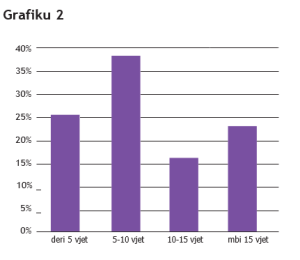
By sentence length::
- • Sentenced to up to 5 years’ imprisonment accounted for approximately 25% of the prisoners.
- • Sentenced to 5 to 10 years’ imprisonment accounted for approximately 38% of them.
- • Sentenced to 10 to 15 years’ imprisonment accounted for approximately 15% of those sentenced.
- • Sentenced to more than 15 years’ imprisonment accounted for approximately 22% of them.
The data are reflected in the graph below:
In the Spaç prison, throughout the years, approximately 55% of the prisoners were recidivists, whereas a portion of the prisoners were also re-sentenced there, during the serving of their sentence.
A highly variable datum has been the origin of the prisoners, which sheds light on a very radical phenomenon such as the development of the class struggle, the scale, spread, depth, and harshness of which, in Albanian society, was such that no one was excluded from it. The class struggle, which, according to the orientations of the Central Committee of the Party of Labour of Albania, at times diminished and at times intensified, but never ceased, presented itself as a source of development, akin to the Heraclitan conceptions of fire, which permeated everything. Clothed in this ancient philosophical garb and, above all, grounded in Marxist ideology, the class struggle was used as the weapon that cleansed Albanian society and profoundly changed social physiognomy, the economy, culture, law, customs, traditions, morality, mentalities, and psychological experiences within a very short time. The millennia-old concept of freedom and the human experience of freedom came and shrank into a wretched conception of freedom, albeit “scientifically argued,” and into an experience of “freedom” that was identified with thinking and living as the Party says and with living as if under siege. The very great variability of the prisoners’ origin also demonstrates the other fact that the data used by the prosecution and the court, as facts to construct the accusation and to impose the sentence, were subjective.
Statistics also show that the largest number of prisoners in relation to the population came from border areas. Even though the Albanian border was a portion of territory surrounded by barbed wire, with electric signals, guarded by armed guards who had the right to kill anyone who approached and who were supported by trained border dogs, living near the border line caused, in that part of the people living there—closer to the other part of the world—the feeling of freedom, the idea of freedom, and the hope of salvation from this self-encircled state that systematically self-annihilated its own population, to remain alive and to pulse continuously. The general data on the fulfilment of the plan, which were compiled in each mine, were extracted from the data kept in registers, where, in separate columns, the fulfilment of the daily norm by each prisoner was recorded, listed as labour power in the mine. The treatment of each of them depended on the fulfilment or non-fulfilment of the norm. The expression “Either the norm, or your life!”—unsupported by any court decision, unwritten on the walls of the prisons, but uttered by all police officers and prison guards, flung in the face of every prisoner performing forced labour—does not differ at all from the expression “Work sets you free,” written at the entrance of Nazi mass-extermination camps. The one appeared immediately and was visible at the entrance; the other was not visible, but was heard every day, for as long as you had life in those prison–labour camps, while its consequences remained hidden and unknown for a very long time—over half a century.
Non-fulfilment of the norm was accompanied by torturous punishments, up to re-sentencing. The indicators of plan fulfilment by prisoners working in mines are increasing, with over-fulfilments every month and every year. Beyond simple statistics and rigid figures—which in any case do not show the technical conditions of the mines, nor the working conditions of the miner prisoners, nor the tools with which they worked, nor the crimes committed against them inside the mines—anyone may ask: But what were these prisoners who worked? What were these prisoners who worked and who were sentenced for non-fulfilment of the norm? What were these prisoners who worked, who were sentenced, and who were tortured for non-fulfilment of the norm? What were these prisoners who worked, were sentenced, were tortured, and were killed for non-fulfilment of the norm? What were these prisoners who worked, were sentenced, were tortured, were killed, and whose bodies disappeared without trace, in the mountains or in the depths of the mines, for non-fulfilment of the norm? On the basis of which law, or of which court decision? In every civilized country of the world, in criminal law, from the definition of criminal offences through to the determination of punishments, their types and measures, the purpose is to prevent the commission of a criminal offence, to punish the person who commits it by depriving or restricting liberty and certain other rights, and also to educate them with the aim of rehabilitation into social life after the serving of the sentence. The way criminal law was constructed, the purpose, the conception of the criminal offence and its excessive expansion, then the entire system of institutions of interception, detection, pursuit, investigation, adjudication, as well as the system of institutions for serving sentences through prison–labour camps such as Spaç and others, gives us the image of a bandit state interested in pushing into crime, in abducting and criminalizing as many people as possible, in sentencing as harshly as possible and in creating pretexts for re-sentencing, with the aim that the prisoner would not leave prison alive anymore; it gives us the image of a state in which those sentenced in prisons were not there to serve their sentence, even less to be rehabilitated, but to be exploited to the maximum as living labour power until death, and even to be annihilated.
In the Spaç prison–labour camp, the norm of the working day for a prisoner included in the labour force of the mine as an unskilled worker—simply a pickaxe-and-shovel labourer who filled and pushed mineral wagons—was the extraction of 8 tons of copper ore in one shift. The work was organized in three shifts, whereas the wage was set by law at 10% of the wage of a free worker, for the same work performed. The prisoners of Spaç, who were exploited for forced labour in the underground of Spaç, over 23 years carried out 88,388 (eighty-eight thousand three hundred eighty-eight) linear metres of mining works. Every new linear metre in the mine was opened solely by the prisoners. Among other tasks were filling ore into wagons, pushing wagons with ore, bringing it to the surface, etc. The prisoners extracted from the underground of Spaç 2.8 million tons of copper ore1 (calculated for the period 1968 – March 1991, when the camp functioned) and around 1 million tons of pyrite ore.
In Table 1 are presented the official state data, which today are in the possession of the joint-stock company “AlbBakër” sh.a., for the production of copper and pyrite ore in the former copper mine of Spaç, by years. The differences in the quantity of ore extracted in different periods also testify to the exploitation that was made of the unpaid labour of the prisoners, up to the year 1990.
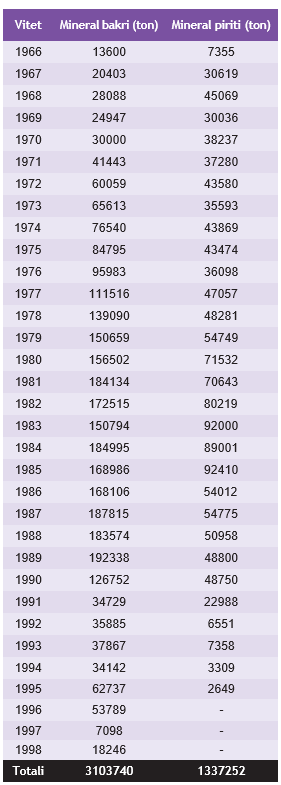
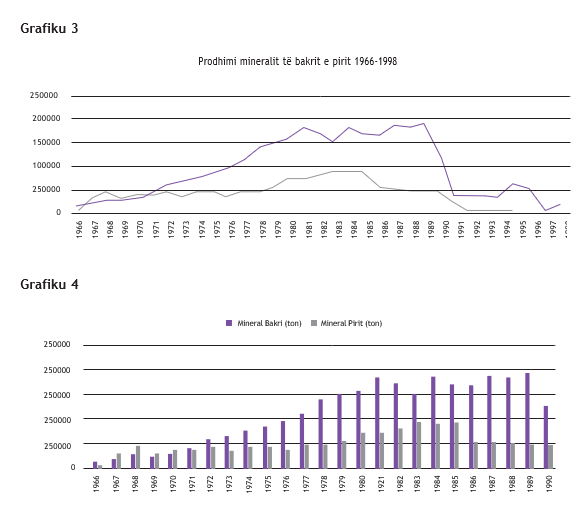
In Graph 3 there is presented, in a linear manner, the extraction of copper and pyrite ore, based on data up to the year 1998. From 1966 until July 1968, only mine workers worked in the Spaç mine. As can also be seen from the curve of the graph, as soon as the Spaç prison was placed nearby, the production of copper and pyrite multiplied. Likewise, with the closure of the Spaç prison in 1991, it is clearly seen from the graph what happens to the production of copper and pyrite ore: the extraction of copper fell to minimal levels, whereas the extraction of pyrite ceased entirely. In Graph 4 the production of copper and pyrite ore is reflected compared with each other, every year, up to 1990. From the copper ore, the copper percentage of which was around 1.15%,2 after processing there were obtained around 35 thousand tons of copper, a quantity which, in the exchanges of the time where copper was quoted from 1900 $/ton to 3500 $/ton, was valued at around 94 million 500 thousand US dollars, or, compared with today’s exchange, i.e., the year 2023, where copper is quoted around 8890 $, its value would be 311 million 150 thousand US dollars.
The product of the toil of the prisoners’ forced labour gave breath to many sectors of the economy. Large quantities of copper ore went to the Wire Plant in Shkodër, where important products for the energy and mechanical industries were produced. A considerable quantity, especially electrolytic copper, was exported, sold in markets, or exchanged through clearing with various states in Eastern Europe, and in exchange agricultural machinery, spare parts, various industrial items, etc., were obtained. The financial reports of these transactions are very difficult to find, because in the system of the dictatorship of the proletariat transparency was lacking and everything developed closed and in secrecy. Even if any document could have existed, for example in the Ministry of Foreign Trade, it was destroyed during the change of the system and the departure of the government connected with that system.
The pyrite ore extracted in the Spaç mine, in an overall quantity of 1,211,154 tons3, mainly went for export, whereas a part was used in the Superphosphate Plant, where chemical fertilizers for agriculture were produced, and also served as a raw material for the production of sulfuric acid (H2SO4), etc. Many of the prisoners who performed forced labour in mines, exhausted by torture and humiliations, in despair, threw themselves onto the barbed wires that surrounded the Spaç prison–labour camp—which could not be crossed and from which no one could escape—nevertheless the guards shot at them and killed them.
Many others died from toil, torture, lung diseases and other diseases contracted in the punishment cells and in rooms overcrowded with prisoners and without living conditions, as well as from the lack of technical safety in the mine galleries, or from violence exercised by guards even during the work process.
The majority of the prisoners received re-sentencings, turning their initial multi-year sentences into almost lifelong sentences. Survivors of communist prisons testify that the state of the dictatorship of the proletariat carried out torture according to manuals that had come from Yugoslavia, the Soviet Union, or Germany, etc. As survivors testify, the Catholic priest Pjetër Meshkalla had opposed the translation, from the German language, of manuals with inhuman torture. Nevertheless, the system had at its disposal people specialized in communist countries for torture, as well as manuals that were translated and applied to the convicted.
The exploitation of the convicted for forced labour in mines, the difficult working conditions, an excessively high norm and severe punishments for its non-fulfilment, the lack of any technical protection at work, the very scant food below health standards, the continuous violence by the police and other service employees in prisons, were factors that caused the outbreak of the revolt on 21 May 1973 in Spaç, a revolt that lasted three days and shook the entire dictatorial state to its foundations. Survivors from the Spaç prison testify that not only were their rightful demands not considered, but the state of the dictatorship of the proletariat reacted with ferocity to suppress the revolt. Entire corps were urgently mobilized and soldiers were replaced with police units. There were so many forces in the encirclement that policemen stood packed shoulder to shoulder. So that the exploitation of these slaves of socialism would continue uninterrupted, the state acted quickly, arresting all the earliest and most active participants in the revolt.
In Spaç, show trials were conducted and death sentences were handed down for four of the participants in the revolt, who were massacred and perhaps some of them drew their last breath before it was fully extinguished and long before the trials were held for them. Tragically, a part of the political prisoners of Spaç even after death still bear the seal of the enemy because they
were sentenced as having committed “terrorist acts.” Hundreds of others, and perhaps more, are endlessly condemned, lost and unburied, because in the cruellest manner and in contradiction with every moral code since the most ancient times, their bodies have been thrown into mountains and streams half-buried or left in nature to be torn by beasts. Their bones are not known where they are, nor how to identify them. The dictatorship of the proletariat was not satiated with tortures against the bodies of the living and mutilations of the bodies of the dead, with the undoing of human dignity, depersonalization, the disappearance of graves.
The former Spaç prison, or the prison–labour camp, will forever be a place of communist crime, a crime committed massively and for half a century in a row, by a system that, through propaganda, deceived the people with beautiful images of freedom and happy life, while it encircled everyone with trenches and barbed wire, so as not to allow anyone even to dream of leaving somewhere else, nor to express any such desire.
Anyone who, even in a naive manner, expressed such a dream, or who dared to try to cross the barbed wires, or fell into a trap and out of fear headed toward the border with barbed wire, was sentenced by the state of the dictatorship of the proletariat not merely with imprisonment, but was subjected to a process of total social negation, alive as dead, whereas dead, lost and without any sign.
Today in Spaç we still have an ongoing crime: the disappeared, around 50 identified former convicts so far, who await that their bones be laid to rest where they should have been, near their relatives, from whom they were violently separated while alive. Every life dies and lives born from it continue, but the deaths of Spaç are different; they are deaths that live… Therefore, Spaç was a hell and today it is a heavy history even to read, a history that shames Albanians and the Albanian state, and compels an apology to all those people and their families, an apology to the younger generations, for the shock caused by the discovery of these crimes. The Spaç revolt will remain in the history of our nation as a breath of hope and faith, under the uninterrupted violence of the dictatorship.
Not by chance, the Parliamentary Assembly of the Council of Europe, in a special resolution, Resolution 1096, already in 1996, emphasized that the legacy of totalitarian communist regimes was not an easy issue to address: “At the institutional level, this legacy included centralization, militarization of civil institutions, bureaucratization, monopolization…; at the level of society, it ranged from collectivism and conformism to blind obedience and other ways of totalitarian thinking. Under these conditions it is difficult to rebuild a civilized and liberal state governed by the rule of law—therefore the structures and ways of thinking of the past must be dismantled and overcome.”
The opening of the secret service files would be a step, alongside other steps—rehabilitation of all former convicts, preservation and conversion into sites of collective memory of prisons and other institutions where crimes against human life and human dignity were committed—so that through the recognition of the truth, illusions about the communist system vanish and the younger generations are oriented toward building other social perspectives where human life, as philosophers teach us from the depths of time and as Kant reiterates, is to be treated as an end and not as a means. Undertaking these steps will serve to build the state governed by the rule of law and to prevent the failure of the process of democratization.
Otherwise, as emphasized in Resolution 1096 of the Parliamentary Assembly of the Council of Europe, “we will see oligarchy installed in place of democracy, corruption in place of the rule of law, and organized crime in place of human rights. In the worst case, we will witness the ‘soft restoration’ of a totalitarian regime, or even the forcible overthrow of a democracy still in its infancy.”
Collected and processed the data:
Luan Ismaili, Anton Dukagjini, Vojsava Delilaj
Jonida Dervishi
“Legal expert at AIDSSH”
Court decisions concerning the convicted of Spaç
The court decisions sentencing all those who served their sentence in the Spaç Prison, including the re-sentencing decisions38 while they were serving a previous sentencing decision in Unit no. 303, testify today to a history of extreme proportions of restricting the freedom to think and to express oneself, up to its total annihilation. And together with it, of every other freedom and right. In some cases, even that of the right to live. What appears immediately from the investigative–judicial files of those who served their sentence in the Spaç Prison is the dominance of sentences for the offence of “agitation and propaganda.” In around 3,040 sentencing decisions41, between the years 1957–1981, the criminal offence of “agitation and propaganda” has been addressed in at least 20 decisions 42 and for it around 75 sentences 43 have been imposed. Of these, from 8 court decisions44, between the years 1973–1981, given to persons against whom, in Spaç, a previous sentencing decision was being executed, all decisions include the offence of “agitation and propaganda” and 44 times the defendants have been found guilty, mainly or among other things, also for this offence45. Familiarity with these decisions sheds light on an anti–freedom-of-thought-and-expression worldview that, in an anti-freedom system, permeates everything: from criminal policy and criminal legislation46, to the harsh punishment measures provided and imposed for offences of “agitation and propaganda”47; implementation in practice, inside and outside the prison; the lack of separation of powers; a politicized judiciary that, instead of being a guarantor of human rights and freedoms and a forum for the objective evaluation of facts, acts as a defender of the Party’s ideological line; court decisions that “ratify” the annihilation of this freedom; one-sided, politicized, non-objective, disproportionate judicial reasoning, full of ideological indoctrination and party/worldview pathos; the standard of proving and determining facts, which, to a large extent and most often, consist of thoughts and words; and up to disproportionality, to the limits of absurdity, in attributing social dangerousness to authors, for offences consummated with thoughts and words.
The positioning and one-sidedness of the judiciary appears clearly in the ubiquitous phrases “our party/of our party” and those about “enlightening teachings from the party48,” or “as the party teaches us”49. The judiciary considers it its own duty to uphold “revolutionary vigilance” and “the development of the class struggle with force and without interruption or wavering, until final victory.”
Expressions are not lacking that highlight what, a priori, the judiciary considers right (and consequently, its opposite unjust), such as: “has spoken against the correct Marxist–Leninist line…. Has spoken against our democratic system and has said that here there is no freedom and democracy”51. Or: “being old enemies of the party, the people and our state, people politically degenerated and with pronounced hostile tendencies against the dictatorship of the proletariat in Albania.”52 Or: “They have carried out hostile activity, as fierce as it is cynical….; with counterrevolutionary intent… they have denied the colossal advances made in our country, in industry, agriculture and other branches of the economy and as a consequence, also the increase, to an unprecedented degree, of the welfare of our working masses…”
The decisions testify to the communist regime’s ‘normal’ consideration of the absurd and its embodiment through judgments. They seem to reveal and represent the worldview of a regime—a worldview anti–freedom of thought and expression. One that does not accept the very existence of different thought and, indeed, attributes to the latter high dangerousness. The consequences in people’s lives from these processes—entirely without the guarantees of due process from today’s standpoint—consist of sentences of several years’ imprisonment, sometimes with re-sentencings of many additional years’ imprisonment, alongside supplementary punishments, and in some cases even death54. These show a regime that erects an entire system for the annihilation of freedoms, remains standing through the annihilation of freedom of speech, and seems to fear most precisely free thought and free speech.
Illustrative of this are: the criminal provision on agitation and propaganda; the high number of sentences and re-sentences for it; the severity of punishments provided for this offence; judicial reasoning with citations of the words or writings of the defendants, together with harsh punishments for thoughts and words, including for the right to hope for change55; and those parts of judicial reasoning filled with ideological pathos in defense of the party and leadership and with characterizations and labels56 that are unethical, insulting, and dehumanizing toward the defendants, inappropriate for the language of the judiciary. These latter, among other things, also reflect worldview aspects, professional abilities, and judicial ethics. All these bring to light, beyond the visible and statistical, to the limits of the absurd, the hallucinatory and even the ridiculous—from the perspective of today’s standards of human rights, due process, and the conception of reality and indisputable truths57—what appears to be a terrible fear, ever present, of everyone—even the judges themselves—of truth, thought, and free speech.
With a harsh criminal policy and criminal legislation and a politicized judiciary defending party ideology, it appears that what defendants think, say, and write—besides being considered sufficient to bring someone before court and sentence them harshly—are not subjected to any objective evaluation (a) as to whether they might be true though disliked by the leadership, or (b) whether there exists a real possibility that through thoughts, ordinary communications between ordinary people, outside prison or among prisoners under conditions of serving imprisonment, words, writings, or poems, goals can be achieved or any concrete consequence can be caused in the direction of “weakening the people’s power,” “undermining the power of the party and the people,” “spreading hostile activity in directions of foreign and domestic policy,” etc.
As to the essence of the decisions, it appears that the standard of adjudication at base is such that reality and truth are considered ‘outside reality’ and ‘fabrications,’ and vice versa. Thus, judges consider outside reality and untrue or fabrications: every word by a defendant that speaks of a better life in capitalist countries; of the benefits of private property; that does not recognize, or worse still, denies what the judiciary sees and recognizes as great achievements in all fields and high welfare; that points to the shortcomings of the system and of rights and freedoms; evidences the suffering of the people or peasantry, the breakdown of relations with other states, or the lack of food items in shops; or articulates that the system is not democratic.
The court decisions show judges’ consideration, as true and within reality, of: colossal achievements in all fields; the unprecedented welfare of the people in our democratic system; the enlightening teachings from the party. They exalt the teachings of the party and, at times, point to the possibility of “re-education” and the right to work, which the party recognizes and gives even to “enemies and their families,” while at the same time also threatening with its “sharp sword,” depending on the stance of the “enemies.”58 With extreme pathos, alongside the teachings of the party, the judiciary does not hesitate to evoke also the people and Albanian mothers in party exaltations and in attributing dangerousness to acts and authors.59 The analysis of the elements of the constituent components of criminal offences is deficient. For the elements of the objective side, it appears that the actions and facts leading to conviction consist of thoughts and words, subjected to evaluation on the basis of the judges’ ideological positioning. The evaluation of the elements of the subjective side, such as the hyperbolized purposes and aims, is unrealistic and appears unreasonable. The elements, generally, are proven through statements by defendants, co-defendants, and witnesses before the investigator and the court. The decisions reflect the indictments (which are more detailed in the description and analysis of facts). They are always upheld by the higher courts. Simply thinking and speaking differently, or against [the line], by anyone, with anyone, and anywhere, as emerges clearly from these decisions, is equated without equivocation with hostile activity worthy of the harshest punishments. Thus, you could end up in Spaç if you had consummated the offence of “agitation and propaganda” by praising life in capitalist countries, mocking leaders, failing to recognize the “great victories of the party,” and “dreaming of going abroad.”60 Or by expressing oneself against the Marxist–Leninist line, sympathizing with life in the West and speaking of freedoms and rights in those countries, as well as by showing displeasure with domestic television programs. You could be re-sentenced while serving the sentence in Spaç for the offence of “agitation and propaganda” consummated with words that noted the breakdown of relations with other states, or by expressing personal thoughts on what might happen in those directions by showing displeasure with collectivization and by saying that through private property one lives better, by expressing that in capitalist countries there is more abundance, in contrast to Albania, where people suffer from low incomes and shops are empty or by expressing thoughts about the Albanian government’s stance regarding Kosovo, or showing displeasure with the herding/collectivization of livestock.
In the decisions against those involved in what is known and commemorated as the “Spaç Revolt”65, alongside the offence of “agitation and propaganda,” the sentences also include the offences of “terror” and “participation in an organization against the people’s power with the aim of committing the crime of economic sabotage.” While identical or similar reasoning is evidenced in relation to the first offence, which generally is “consummated” with words and slogans, for the other serious offences there is lacking a genuine analysis of each element of the criminal offence, an objective assessment of the facts, the means available, and the concrete possibilities of achieving the alleged aims.
The analysis of court decisions helps one to see and evaluate the communist judiciary through its own words. The judiciary, in its own words, comes to us as part of a system without separation and balancing of powers and generally without balance; as a politicized judiciary and defender of the party’s ideological line; with disproportionality in reasoning and pathetic ideological refrains; with lack of objectivity and extreme one-sidedness in adjudication; with lack of guarantees for defendants and lack of defense counsel; with deficient evaluations; indoctrinated and with language inappropriate for judicial decisions. The judiciary, in its own words, appears as an important link in keeping a dictatorial regime standing. The judiciary, in its own words, comes to us as the manifestation and embodiment of an anti–freedom-of-thought-and-speech worldview, as well as as the executor of every other freedom. It remains important to study and analyze the communist judiciary, as we aspire to concrete results in the effective practical implementation of the best standards of human rights and due process, as they are provided today by the Constitution of the Republic of Albania, the European Convention on Human Rights, and the case-law of the European Court of Human Rights.
Others:
Imagine those men. In uniforms of brown colour. Poorly fed. Poorly clothed. Living poorly. Those accursed men who do not see their families, who do not caress their children and who often are themselves almost children. Who work underground, who are punished underground, and see only earth. Imagine those men—walling in the mud of the mine, who pull wagons with copper and pyrite and are given to eat only a single bowl of soup. They are slaves. Even if they achieved 100% of the work norm, they benefited only 10% of the wage of a miner under conditions of free labour. A study by the current deputy director of prisons, on the systems of serving sentences under the dictatorship, Femi Sufaj, highlights that the forecast for the fulfilment of the norm was up to 225%. In this case, a simple imprisoned worker benefited 35% of the wage realized. If the fulfilment of the norm exceeded this limit, the payment did not change. For persons who did not fulfil the norm 100%, the payment was calculated in inverse proportion, that is, as a reduction. “In the year 1972, with Council of Ministers Decision no. 152, Council of Ministers Decision no. 120 dated 9.9.1968 on the remuneration of the labour of convicts was amended. The payment of convicts who work was re-established up to 15% of the wage set for the same work. And some improvements were made in the food ration by increasing 100–160 calories through the introduction of vegetables. Nevertheless, based on the data of the Institute of Hygiene and Prophylaxis, the calories that a convict received were much lower than the minimum recommended values,” Sufaj writes in the book “The System of Punishments in Albania during the Communist Regime (1945–1990)”.
MILLIONS THE STATE EARNED FROM THE PRISONERS
It is of interest to note that from the labour of prisoners’ considerable revenues were secured for the state budget, which were then used, besides the needs of the Ministry of Internal Affairs, mainly by the Ministry of Finance for investments in other sectors. Sufaj examines several reports on the economic balance of revenues created by prisoners’ labour and emphasizes that they undertook the most difficult jobs in the country and constituted an important factor in increasing revenues. “In the year 1948, the realization of revenues from prisoners’ labour is reported at 10,780,420.50 lek, at the exchange rate of the time. During the year 1950, 16,000,000 lek are reported,” Sufaj notes. Only from Spaç, according to Femi Sufaj, the Albanian state secured in the year 1979 the sum of 3,537,0001 lek, whereas in the year 1981 the sum of 219 3984 lek, whereas in the case of the draining of the Maliq swamp during the year 1950, 900 convicts worked, who performed 110,000 workdays and secured 12,671,741.50 lek in revenue; during the year 1951 in this camp 1,085 convicts worked, performing 148,026 workdays and realizing 22,773,449.65 lek in revenue according to the Archive of the Ministry of Internal Affairs (Fund Branch of Camps and Prisons, D.17, Y.1951). According to statistics drawn from the calculations of the Files Authority, over the 23 years that Spaç was turned into a forced-labour camp, 2,000 prisoners produced 2.82 million tons of copper and 1.3 million tons of pyrite, which translate into 2,500 kg of gold, says Gjergj Marku, member of AIDSSH. Engineer Halit Shqarthi observes that in the year 1969, the mine extracted only 50 thousand tons of copper, whereas in the year 1981, with the increase in the number of prisoners, production increased fourfold, around 200 thousand tons per year.
A DOLL FOR THE DAUGHTER
Fatos Lubonja is perhaps one of the convicts who has been able to clarify the routine of the camp better. The description of workdays that began at 5 in the morning, naturally does not avoid the norm. “They used to say material–bodies–holes. If you did not do the norm you ate the punishment cell as punishment, or, you stayed bound in irons outside and especially when you broke the rules.” When he was sentenced to prison, he left at home two daughters, the youngest only one month old. It was his mother’s letters that kept him alive by describing to him every week how the daughters were growing. “The work they did was unbelievable. Once I entered a competition in the mine and we made advance. So much advance we made that we exceeded the norm and I remember that I took 3 thousand lek, then I bought the girl a doll. It was a competition, a work competition among the prisoners,” he recalls in a testimony given to AIDSSH about Spaç.
GËZIM ÇELA, THE GUITARIST OF THE SPAÇ CAMP
For a time, the Spaç camp had a room that the prisoners also called the culture room. Gëzim Çela recalls that they had a friend from Fier who was a good mandolin player. “He used to tell me, Gëzim, find us a guitar because music cannot be done only with a mandolin. When my mother came for a visit, I told her to meet the guitarist Medi Prodani and tell him that Gëzimi wants a guitar. He himself had not had a guitar and had told Vaçe Zela, whom I knew because I had been her childhood friend.” Çela says that Vaçe Zela’s guitar went to the camps where Gëzim Çela was. It is almost legend that on the days of the revolt, in the Spaç camp, the sounds of a guitar were heard. The former convict Gëzim Çela attributes the merit for these sounds to Skënder Daja, a former convict and one of those executed as an organizer of the revolt. “At one moment, I remember that Skënder Daja had climbed onto the terrace, had taken my guitar, the guitar that Vaçe Zela had brought me.”
“The Party cared more for the cows’ stalls than for people.” This sentence, said carelessly by Pal Gjergj Zefi from Rrushkulli of Durrës, in his thirties, sends him to Spaç prison for agitation and propaganda. It is the year 1973; the time of liberalization has ended. Pal Zefi arrives at the prison among the mountains, in a ravine where the traces of humanity are no longer felt. He begins his 10-year sentence by refusing to work in the mine. He insists on serving the sentence with imprisonment, not with forced labour.
To his refusal, the command responds with isolation. When he completes the first isolation, he again refuses the work and is left again in the damp punishment cell. The isolation was done in dark and narrow cells and the convicts were given at night only one blanket, which was taken from them in the morning.
At 5 in the morning of 21 May 1973, the guard enters Pal Zefi’s room to take the blanket. Zefi, who has spent time in darkness, runs out of the isolation room, his hand catches a metal rod and he climbs onto the terrace. The guard calls on him to return to the punishment room; Zefi refuses and asks him to stay away, because he would strike anyone who came near him.
While to the guard’s aid Fejzi Liço come some policemen, the convicts who had awakened go to Pal’s aid. The clash begins between the political prisoners and the guards of Unit 303. For many of the convicts, everything was spontaneous and unorganized.
“Awake was only the first shift, 1/3 of the convicts who would go to the mine. I was second shift and I was asleep at that hour. I wake up from the noises. Near me I had Fiqiri Mujo and Ali Hoxha. I ask what is happening. They tell me to be silent because I had only 3 months to finish the sentence. But I could not stay. The commotion could be heard; the screaming had begun,” recalls the former convict, Shkëlqim Abazi. He goes to the window and his sight caught the convict Muharrem Dyli who slaps the policeman who was striking Pal Zefi.
“The policemen rushed to seize Pal Zefi, but we the prisoners instinctively stopped them and we even began to throw some punches. The cap of the guard officer, Fejzi Liço, fell to the ground and the star of the cap was stepped on,” says the former convict Gëzim Çela. According to another convict, Nuri Stepa, between the policemen and Pal Zefi had entered Pavllo Popa and Syrja Lame, while the latter struck the operative.
At this point the testimonies are blurred. Fifty years later, it is difficult to reconstruct the event; nevertheless, Abazi recalls Tarti—the dog that his friend Fiqiri Mujo raised—who comes out of the sleeping quarters and goes to the prisoners’ aid by attacking the policemen. “A man from Shkodër who was there tells the comrades ‘Tarti has shamed us, he is fighting with the policemen and you are watching’. These were the sparks that set the fire. Everyone got up—20, 30, 40 people—how many there were I do not know. The policemen found themselves in a very bad situation, their caps fell around the foundations and they ran away,” says Abazi. (His version is almost confirmed by the file on the event, according to which the policemen left because the situation had become tense.)
Tarti, the prisoners’ dog, would be executed as an insurgent after the revolt. The former prisoner Nuri Stepa gives the example of the animal to illustrate the cruelty. “Without any shame they have executed even the dog because he joined with us, against the policemen. But he attacked the policemen and they fell into the pit.”
THE HOURS OF THE INSURRECTION
After the initial tension and the fleeing of the policemen, it seemed that calm fell in the camp. A part of the first shift had gone to work in the mine.
The documents of the file suggest that in the camp there were no developments until 15:30, when the operative–investigative group arrived there and Pal Zefi was arrested and after him Syrja Lame, who was taken to the isolation room. But when the operative group wanted to arrest Pavllo Popa and they were escorting him to the isolation room, Pavllo escaped the policemen and entered among the crowd of convicts, who immediately took him into protection, shouting “either death or freedom,” “we do not work in the gallery,” “you are murderers,” etc.
The camp was now under the control of the convicts, who broke the emulation boards with communist slogans, while on the evening of 21 May the punishment cells were opened and the isolated were brought out. Some of the convicts went onto the terrace and into the roll-call square. Witnesses say that Skënder Daja, Dervish Bejko and Bashkim Fishta began to give speeches and to recite anti-communist poems. In a conversation for “Newsbomb,” Nuri Stepa describes with emotion the hours of the revolt. “We were chanting ‘down with communism’ and ‘down with Enver Hoxha’. Skënder Daja, whom we called ‘the little pup’, called on the army to join us, because they were our brothers. The roll-call square was full, while above our heads helicopters were passing. Beyond the command building, tanks had also arrived. At 1 at night on the date 22 May, in the camp the flag without the communist star was waving. The red piece was taken by Rexhep Lazri from the quilt, while the eagle was painted by Mersin Vlashi. The flag was raised by Gjet Kadeli, Rexhep Lazri and Murat Marta, while Ndrec Çoku stood guard. At one point a burst of automatic fire began. The bullets were passing above our heads. They were shooting at the flag, but not a single bullet hit it.”
Two hours after the flag of the revolt began to wave, the deputy minister Feçor Shehu had arrived in the camp. The file notes the time 03:00 in the morning. Officially, at 08:00 the command calls on the convicts. Nuri Stepa, the witness who speaks for “Newsbomb,” is one of three prisoners who went to speak with Shehu.
““He had come at night. In the camp it was said that Kadri Hazbiu was also with him. Koço Papa had gathered us at the canteen, representatives of each region, to decide our demands, where we said that we demand not to be re-sentenced, not to work in the mine, etc. We wanted Feçor Shehu to come down to speak, but he said that a delegation should go up. Then I went out with Paulin Vata, who had been an officer.
We passed the area of the camp below and we were in a danger zone; both sides were outside buildings, but we could be killed. Indeed, a friend of mine, Bep Konomi, held me by the hands when I went out; he told me do not go out because they will kill you so that they make us submit here. But we went out. The meeting was a meeting of war. The letter with demands I gave to a policeman.”
Feçor Shehu ignored the demands and after asking them who they were, said they should communicate to the others to separate aside those who did not want to work, while they would find the guilty themselves.
Suddenly, from the crowd of convicts, Stepa says, Hajri Pashai broke away and approached the delegation. “Feçor asked him who are you, and Hajriu introduced himself. Feçor told him you are the son of Zenel Pasha, the one who killed the old men and old women of Hekal. No, said Hajriu, you have forgotten that you once held the bridle of his horse,” Stepa recalls, while Shkëlqim Abazi adds that “Pashai and Feçori were from the same area. But where is there a greater criminal than you, Hajriu told him, you are a dish-licker. You licked Zenel Pasha’s boots when he got down from the horse, he said; you would bend your back so he could put his foot, he said; but you are a criminal. The conversation of Hajriu with the deputy minister reached a very vulgar language …. I am a witness myself.” The delegation went down into the camp, after Hajri Pashai warned him that Feçor Shehu’s end would come from his own people, as would happen later.
Below they were received with cheers. Now the prisoners had had two days not going to the mine but they had also had two days without food, while the command had also cut off their water.
“We had neither to eat nor to drink. They had stopped our water. To drink we had kept a tank from what we used to wash,” says Nuriu. The hours of freedom were coming to an end. “On the morning of the 23rd, special forces entered with helmets, with iron crowbars and cauldrons with wire so as to bind us. There was hand-to-hand confrontation with the police. They began to throw tear gas as well. We were also powerless. They seized us in groups and bound us.
Dervish Bejko, Dashnor Kazazi, Jorgo Papa and Skënder Daja resisted until the end. They had climbed onto the terrace of the camp. They resisted. When they had bound all of us, Feçori entered. He passes near us and goes up onto a curb. The first thing he said was: where are those who came to speak with me. Arrest them. We were all bound. The revolt was suppressed. It would be suppressed because we had nothing, no weapons, nothing. We had the state against us. Hajri Pashai had been bound and was near me. I had him as a friend. He was a very strong boy. When they arrested us on 23 May, that day I had on a jacket and a coat. In my pockets I had put 5 packets of ‘Lux’ cigarettes and 2 canteens of water. I tell Hajriu who was near me, take 2 packets and 1 canteen of water. That was the last conversation with him. In the prison van they told me that he had treated everyone with cigarettes, had told them they were from me,” recalls Nuri Stepa. “Their resistance was overcome with violence,” it is written in the report of the camp command on the event. Army forces went from Tirana to Spaç. Many of the convicts were arrested, 12 of whom were given a quick trial that same night, among whom also Pal Zefi (32 years old), Skënder Daja (28 years old), Dervish Bejko (27 years old) and Hajri Pashaj (23 years old), who were sentenced to death, whereas 8 others were sentenced to 25 years each.
Stepa is taken to Tirana for investigation and faces investigator Mehdi Bushati. Another investigator who is with him tells him that Skënder Daja until the end had said down with communism. Then they show him the photographs of the friends. “I have seen the executed; they were on a river gravel,” says Nuriu, who was re-sentenced to 13 years and was taken to Burrel.
At the meeting of the Presidium of the People’s Assembly on 24 May, the chairman of the Supreme Court, Aranit Çela, observed: “we say that they should be sentenced to death (shooting) and that they should be shot not in front of the others and not in front of the camp.”
The exact time of when the four were shot is not known; the place of execution likewise, but Çela’s order was carried out. To the arrested who were in the investigation they showed the photographs of the killed. 66 prisoners classified as the most active in the revolt were re-sentenced. On the day of the revolt, Pal Zefi had said that he would not return alive to the punishment cell. They forced him to keep his word. The valley of terror took him with it without leaving him even a grave where he may rest.
YEAR 1946
On 6.12.1946 the Minister of Internal Affairs Koçi Xoxe sends a letter to the Ministry of Public Works and to the Ministry of Agriculture and Forests where, among other things, he emphasizes: “In prisons we have a considerable number of prisoners who are fed and eat bread in vain. In order that they be activated in work and especially that the sentence given with forced labour be executed, this ministry has raised as a problem the inclusion of convicts in work.…”
COLLABORATORS
Information about the revolt was given by 16 collabourators of the Security: “Zjarri”, “Shpata”, “Planeti”, “Kaike e Bukur”, “Shigjeta kaltër”, “Bakri”, “Zjarri i Dytë”, “Pushka”, “Libri”, “Stilografi”, “Pisha”, “Vigjilenti”, “Qarri”, “Semani”, “Besa” and “Vullnetari”. The Security had an expanded activity inside the camp.
Indeed, even one of the representatives of the prisoners who met with Feçor Shehu would become, under coercion after the revolt, an agent of the State Security.
THE CIRCLES OF HELL
““You must keep in mind that Spaç had one thousand men, but like that hell, Spaç too had
its circles. There were some who did time in Spaç who passed the prison like in a hotel: no work, played chess and stayed there—these were unfit for work. There were others who worked in the library, kitchen, depot, etc. There were others who worked in the gallery, but it depends what gallery and it depends what front. Where I worked, the second zone, it was absolute terror. When I read Dostoevsky, I said may this take the evil away from me, nothing, it did not impress me at all. Spaç was far more terrible, more horrific, a backbreaking work that only my young age could withstand”—Ilir Malindi, former convict in Spaç.
THE MOVING CAMP THAT BUILT THE COUNTRY
Unit no. 303 was placed in Spaç of Mirditë in the year 1968; its beginnings are on 25 May 1951, when by order of the Minister of Internal Affairs Camp no. 2 was created, which later would be called Unit 303. In the years 1951–1968, it served as a “moving” work unit. Its beginnings are in Peqin, where the convicts opened the Peqin–Kavajë canal; then they worked in the construction of the aviation field in Ura Vajgurore, the Devoll canal, the Rinas airport, the Sanatorium, the meat combine, the tannery, some buildings in the Gjergj Dimitrov farm, the Tractor Plant, the Caustic Soda Plant in Vlorë, etc. In Spaç, according to documentation, we find it with the name “Re-education Unit”. In Spaç it is calculated that there were 2,000 prisoners in the years 1968–1991, of whom 32 lost their lives. Prisoners sentenced to death: 7; killed in an escape attempt