

History
To read the history of the Spaç prison-camp, click here.
By a special order of the Minister of Internal Affairs, Camp No. 2 is established. The opening of this camp marks the origin of the history of the Spaç prison-camp. During the years 1951–1968, it functioned as a “mobile” labour unit, and those who worked there were all political prisoners.
By special order of the Minister of Internal Affairs, Camp No. 2 was established. The opening of this camp marks the beginning of the history of the Spaç labor camp. From 1951 to 1968, it served as a 'mobile' work unit, and all who worked there were political prisoners.
"During this period, the camp followed a specific itinerary based on the needs of the time. Initially, it worked on the opening of the irrigation canals Peqin-Kavajë, Devoll-Thanë, Vjosë-Levan-Fier. Afterwards, upon completion of the works in Peqin, it moved to Rrogozhinë-Harizaj-Lekaj-Gosë-Kavajë, and finally to the village of Çengelaj in Peqin.
Until March of this year, it assisted Camp No. 1 in Ura Vajgurore in the construction of the airfield. It was then transferred to Vlashuk near Kuçovë, due to the need for works for the construction of the Devoll–Thanë irrigation canal, with a length of 8 km. The camp was transferred to Rinas for 4 years for the construction of the airport.
The Vjosë-Levan-Fier irrigation canal was constructed; for this reason, the camp was transferred to Shtyllas in Fier.
The camp was moved again to Tirana for the construction of the Sanatorium, the Meat Combine, the Pellicery, the construction of several buildings at the 'Gjergj Dimitrov' farm, and also for part of the work at the Tractor Factory.
Camp No. 2 was moved to Vlorë, where it worked on the construction of the city’s Caustic Soda Factory.
Two years later, the prisoners were sent to Elbasan for the construction of the Cement Factory.
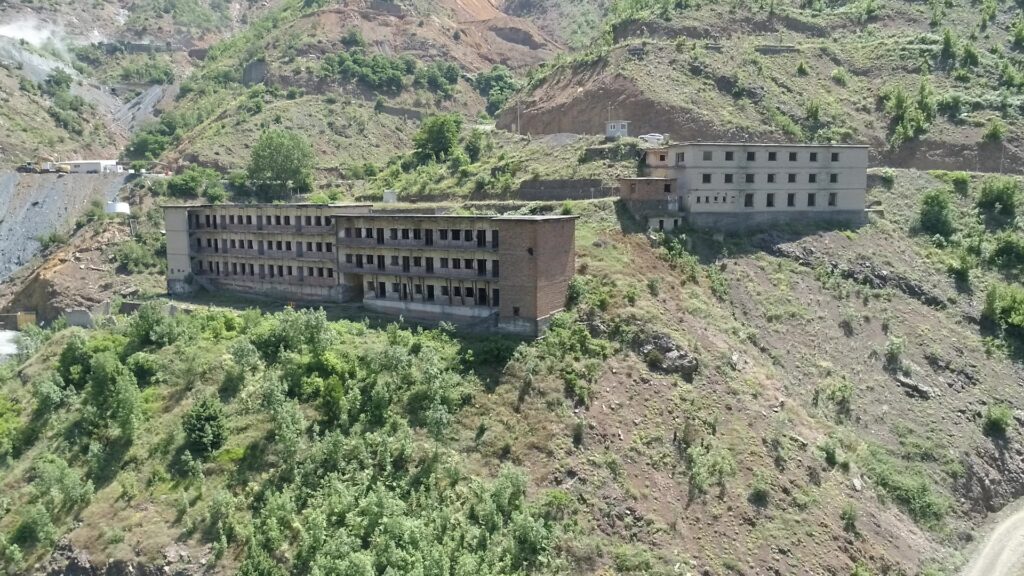
1968 – The camp was finally established near the pyrite mine in Spaç, where it would become historically known as Re-education Unit No. 303 in Spaç (Unit 303). In reality, it was not a re-education camp, but both a camp and a prison.
The Branch of Internal Affairs in Mirditë, the body of the Ministry of Internal Affairs that supervised Unit 303, Spaç, due to its political, economic, and strategic importance, decided to open the file of the “object of special importance for Re-education Unit No. 303, Spaç–Mirditë” (ORV) - Operational Sentence-Execution File.
The Spaç Revolt took place, otherwise considered the first revolt and the most significant in the prisons of communist Albania. After the violent suppression of the revolt, 4 political prisoners were executed by firing squad, while around 70 others were re-sentenced.
In addition to political prisoners, documents from the ORV file show that the Spaç prison-camp also held ordinary prisoners, who worked in the Spaç copper mine, extracting copper and pyrite material
From Spaç, political prisoners were initially transferred to Qafë Bari, to Prison 313 in Tirana, and later to Unit 305 in Sarandë. There, only ordinary prisoners remained, until the end of July 1991.
The Spaç prison-camp was permanently closed
The file of Re-education Unit No. 303 Spaç was permanently archived several months after the communist regime in Albania had been overthrown.
Reference: AIDSSH, Fund. Directorate of Internal Affairs Mirditë, File ORV, No. 123, “Unit 303 Spaç”